What to Look for in a North Texas Home Inspection
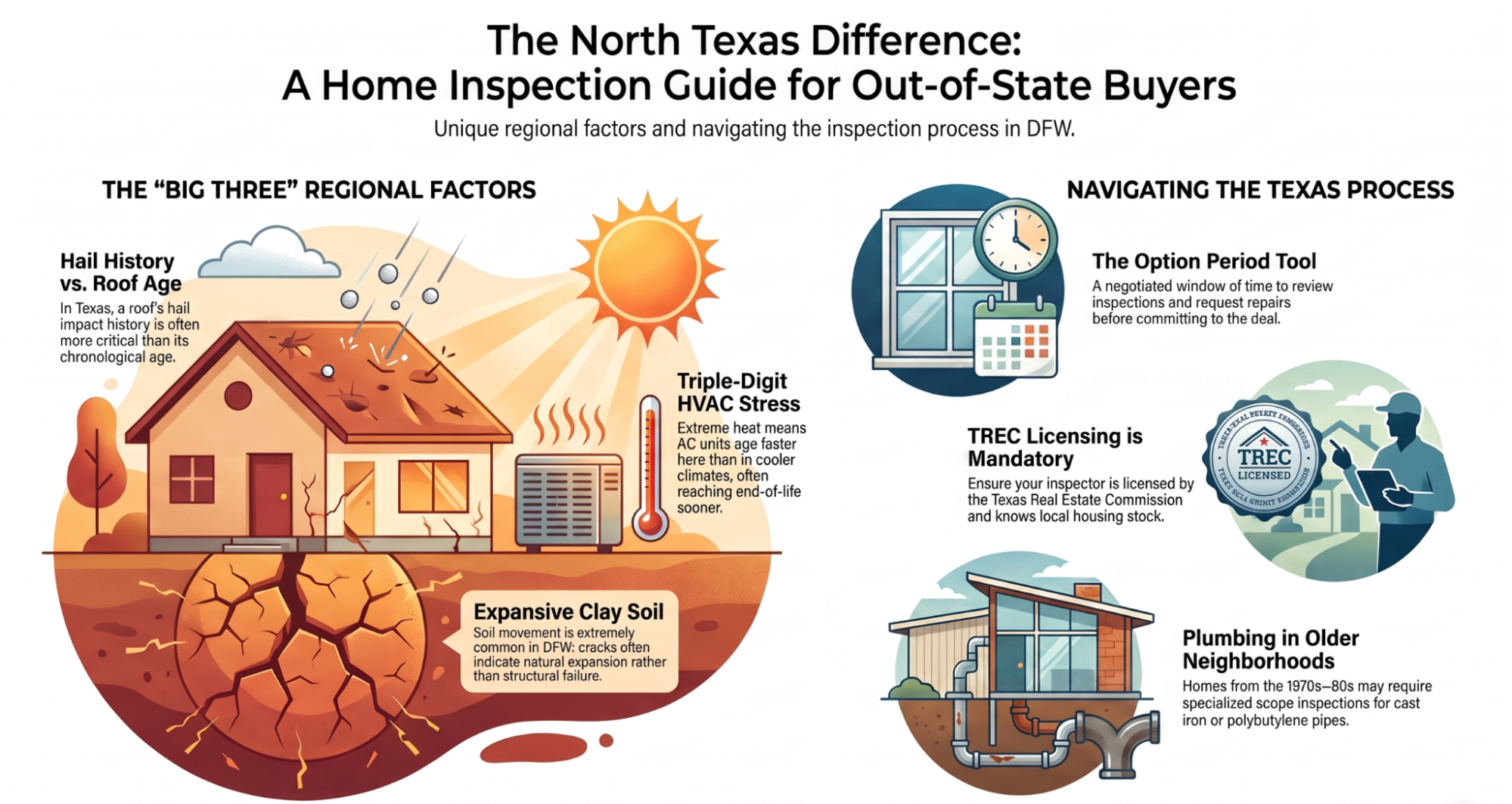
A home inspection in North Texas covers the same basics as anywhere else — roof, foundation, HVAC, plumbing, electrical — but the specific issues to look for are shaped by the region's clay soil, intense hail seasons, and extreme summer heat. Out-of-state buyers purchasing homes in Richardson, Plano, Garland, or the broader DFW area often encounter foundation reports, hail damage disclosures, and HVAC age questions they were not expecting. Knowing what these mean before you get the report is the difference between a confident decision and a panicked one.
If you are buying a home in North Texas and you have been through a home inspection somewhere else — Ohio, California, the Pacific Northwest, anywhere with different soil, different weather, different building conventions — the inspection report you get here will look different.
Not worse. Not better. Different. And if you do not know what you are looking at, the differences can feel alarming when they are not, or forgettable when they actually matter.
This is one of the most important conversations we have with our relocation clients before they go under contract. Here is what we cover.
Why North Texas Home Inspections Look Different from Other States
Most states have their own version of standard inspection items. What makes North Texas specific comes down to three things: the soil, the weather, and the age of the housing stock in cities like Richardson and Garland.
The soil. The Dallas-Fort Worth area sits on expansive clay soil — sometimes called black clay or black cotton soil — that expands when wet and contracts when dry. Over time, this movement puts stress on foundations in ways that buyers from other regions are simply not used to seeing on inspection reports. It does not mean the home has a problem. It means the home is in North Texas.
The weather. Hail is a regular occurrence in this part of Texas. A significant hail event can damage shingles in ways that are not visible from the ground but show up clearly in an inspection or a roofing assessment. This matters at closing because insurance companies look at roof age and condition closely.
The housing stock. Richardson, Garland, and parts of Plano have a significant amount of homes built in the 1970s, 1980s, and 1990s. That means some older plumbing materials, some HVAC systems that have worked hard for a long time, and some features that need a closer look than a newer construction home would.
None of this should scare you away from a home. All of it is worth understanding before the inspection report lands in your inbox.

Foundation: The Most Important Line Item in a DFW Inspection
If there is one section of a North Texas inspection report that catches out-of-state buyers off guard, it is the foundation section.
In most of the country, a foundation report that notes movement or settling is a significant red flag. In North Texas, some degree of movement is extremely common — because of the clay soil, almost every home in the region has experienced some level of expansion and contraction over its lifetime.
What the report might say: Inspectors often note pier and beam or slab foundation systems, visible cracks in interior drywall or brick veneer, minor variations in floor level, or doors that do not close perfectly. These may or may not indicate an active structural issue.
What to do with it: The key question is not whether there is any movement — there almost always is. The key question is whether that movement is active and ongoing, or whether it happened years ago and the home has been stable since. A structural engineer assessment (separate from the standard inspection) is the tool for answering that question, and it is something we routinely recommend when the inspection raises foundation questions.
What we do: We help our clients understand what the report is actually saying and whether a structural engineer consult makes sense for a specific home. We have navigated this conversation many times in Richardson, Plano, and Garland — it rarely ends the deal, but it almost always needs to be addressed clearly before closing.
The Roof: Hail History Matters More Than Age Alone
In most of the country, roof age is the primary concern on an inspection. In North Texas, hail history is equally important — and sometimes more so.
A roof that is eight years old but took a significant hail hit three years ago may be in worse shape than a fifteen-year-old roof that has been well-maintained in a lower-impact area. The visual damage from hail can be subtle — granule loss on shingles, soft spots that are not obvious from the street — but insurance companies and roofing contractors can identify it clearly.
What to look for:
- Granule loss in gutters or on the ground near downspouts
- Soft spots or dimpling on shingles visible during an inspection
- Age of the roof relative to the last major hail event in the area
What it affects: Homeowners insurance in North Texas takes roof condition seriously. A home with hail-damaged shingles may be difficult to insure at standard rates until the roof is replaced, which can affect your closing timeline or your negotiating position.
What we do: When roof condition comes up in an inspection, we help clients understand their options clearly — whether that is negotiating a repair credit, requesting replacement before closing, or adjusting the offer based on the estimated cost.
HVAC: Texas Heat Changes the Math
A heating and cooling system that would last twenty-five years in Minnesota may not last that long in a North Texas summer. Air conditioning units in DFW run hard — sometimes for eight or nine months of the year — and that continuous use accelerates wear.
What the inspection will look for:
- Age and condition of the air conditioning unit(s)
- Whether the system is appropriately sized for the home's square footage
- Evidence of deferred maintenance (dirty filters, blocked drainage lines, refrigerant issues)
- Condition of ductwork, especially in older homes with original systems
What out-of-state buyers miss: A system that is only ten years old may already be approaching the end of its useful life in a Texas climate, depending on how hard it has run. Age alone does not tell the full story — the inspector's assessment of current condition and the service history (if available) matter just as much.
An HVAC replacement in North Texas is a meaningful cost, and it is the kind of thing worth knowing before you finalize your negotiations. We build this into our pre-offer conversations with relocation clients whenever the home has an older system.
Plumbing: What Older Neighborhoods Need Extra Attention
In the established neighborhoods of Richardson and Garland — homes built in the 1970s and 1980s — original plumbing materials are sometimes still in place. Cast iron drain lines, polybutylene supply lines, and galvanized steel pipes are all possibilities in homes of that era, and all of them have known longevity considerations.
What the inspection covers:
- Visible supply and drain lines in accessible areas
- Evidence of prior leaks or water damage
- Water heater age and condition
- Exterior hose bibs and irrigation systems
What it does not always catch: Some plumbing issues only reveal themselves through a more specialized scope inspection, particularly for cast iron drain lines that may be corroding or root-compromised underground. This is worth discussing with your inspector if the home has original plumbing and is more than thirty years old.
How to Choose the Right Home Inspector in Richardson, Plano, or Garland
Not all inspectors are equally familiar with the specific issues that show up in North Texas homes. When you are selecting an inspector, look for someone who:
- Is licensed through the Texas Real Estate Commission (TREC) — this is required in Texas, not optional
- Has experience with the specific housing stock in the neighborhood you are buying in (established 1970s-80s homes versus newer construction have very different inspection profiles)
- Is willing to walk you through the report in person or on a call, not just email you a PDF
We have inspectors we have worked with repeatedly in Richardson, Plano, and Garland — people we trust to be thorough and to explain findings clearly to buyers who are not local. Ask us for a referral before you go searching on your own.
What to Do When the Inspection Report Comes In
The inspection report is not a pass/fail document. It is a detailed record of everything the inspector observed — and it will include minor items alongside major ones, often without distinguishing clearly between the two.
What to read carefully: Foundation notes, roof condition, HVAC age, any evidence of prior water intrusion, and any items flagged as safety concerns.
What not to panic over: Every older home in North Texas will have a list of deferred maintenance items — light switches, loose fixtures, caulking, minor drainage grading. These are normal. The inspection report is designed to document everything, not to rank it by significance.
Your option period is your tool. In Texas, the option period gives you a negotiated window — typically a few days — to review the inspection, request repairs or credits, and decide whether to move forward. This is when your agent earns their fee. We work through inspection findings with our clients directly, help prioritize what is worth negotiating, and handle the back-and-forth with the seller's side so you are not doing it alone from another state.
We covered the Texas option period in more detail in our guide to searching for homes in Richardson as an out-of-state buyer.
We Have Been Through This Process — A Lot
Our relocation clients do not walk into an inspection blind. Before the inspector ever sets foot in the home, we have already flagged the items most likely to come up based on the age, location, and condition of the property.
We know what foundation movement looks like in a Canyon Creek home versus a newer Plano build. We know which Garland neighborhoods tend to have original plumbing. We know how to read a hail damage report and what it means for your insurance conversation.
You should not have to figure this out on your own. That is the point of working with an agent who has done this in this market, on this soil, with buyers in the same position you are in.
Ready to talk through what to expect in your search?
- Learn About Our Relocation Services
- Browse Homes for Sale in Richardson, Plano, and Garland
- Read Our Full North Texas Buyer's Guide
- Read Our Richardson Home Search Guide
Let's talk before you go under contract.
Housed Real Estate + Relocation
204 E. Main Street Richardson, TX 75081
(214) 888-6864
Info@HousedRealEstate.com